Tuesday, April 15, 2008

Worlds in Collision


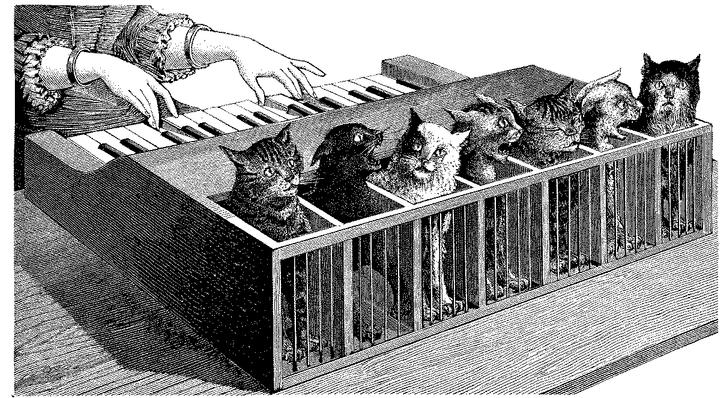
Was reading my copy of IEEE Spectrum this morning at 5 am and found a description of my friend Frieder's work. Very beautiful.  Looking forward to working with him again in just a few days.

Labels: , ,

Friday, April 4, 2008

More devils than birds in the sky

A great number of demons in the Vatican, some quite voluptuous, some rakish, some horrific, but all kinda appealing. While we all hope for an eternity spent in quiet contemplation of the Celestial Visage, the fires of Hell and the activities of its residents make a far more winsome subject for the visual arts.  

Labels: , , ,

Sunday, March 30, 2008

Desire Line

art5_08

Thom Blum had a beautiful installation at the Cowell Theater last night, comprising a long hallway, a collection of friends' ipods and an assortment of speakers donated by Boston Acoustics.  I've been hearing him talk about the piece as it developed, but it was far more striking and far more intense than I imagined.  Having experienced it, I don't know why he hasn't done installations like this before, because it so perfectly connects to his oeuvre. A number of his concrète pieces are travelogues: recordings made from captured sonic landscapes of far away places. Years ago he wanted to build a Walkman/iPod-like device that would process the sound around you and feed it into your earbuds.  The new work is a travelogue of sorts, a collaboration between Thom and one's perambulation through it, glimpses of sound and music past and present near and far, including a modified bit of The Comfort of Solitude from The Bed You Sleep In. Oh, let's listen for a moment to that old chestnut, shall we?


The hallway led to a performance of Deborah Slater's Desire Line, one of her best works, featuring a number of my favorite dancers and social-networking site friends: Kerry Mehling, Travis Rowland, Shaunna Vella; and based on the paintings of Alan Feltus (see example above).  Travis and Kerry dance as one person, both amazingly fluid and strong, with spectacular moves following in unanticipated succession.  And the all-important-and-possibly-my-reason-for-being-in-the-arts cast party was a religious ecstasy of salmon and flan incroiable and broken glass and Absolut and lithe inked flesh in 104° water. Some parts of it seem to be missing after the fifth tumbler but even though Lynne had to leave early, driving off in her rented Mercedes, I'm relatively sure I was nothing if not the perfect gentleman in the aftermath.

Labels: , , , , , ,

Monday, March 3, 2008

Meditation on Jon

Composing music is a strange ephemeral artform, constructing something from the almost nothingness of sound, pressure-wave vibrations of the air.  But this strange ephemera is somehow able to touch deep inside the listener, bringing up emotions and reactions pleasant and unpleasant but impossible to ignore. In the films of the Hollywood mainstream, the emotional power of music and its ability to pass by the viewer's defenses is often used to manipulate, to subliminally broadcast to the listener how they are supposed to feel. But music in Jon's films is different. Although it carries a large part of the emotional weight of his films, it is not a hidden wedge into the viewer's heart.  In fact, it is usually banished from those scenes which are the most directly narrative and kept to those long minimal moments of repose that are so dear to Jon.  It is given an equal billing, with narrative, with the landscape, with the characters, part of a set of parallel threads that each relate to the viewer a different aspect of the story.


I first met Jon at a screening of All the Vermeers in New York at the Pacific Film Archive in Berkeley California. The producer, Henry Rosenthal, whom I had known through the Just Intonation Network years before, called me and told me I had to come, that it had been a labor of love and that he was quite proud of it. When I saw it, I was enraptured.  I loved the look of it, the pace of it, the feel of it, and especially the music by Jon English.  It was such a musical film, both indirectly, with a feel for rhythms on the short and long and architectural scale and directly, leaving space for musical development that Jon English filled so beautifully, especially in the long tracking shot dancing among the columns of the lobby of some Wall Street location.  


A few years later, as Jon Jost's Sure Fire needed to be finished for its debut at Sundance, Henry called me while I was staying in a room in a businessman's hotel in Japan that was the size of a smallish shoebox and told me that Jon English was too ill to finish the music, in fact that he had written only a short melody for pedal steel; that the music had to be done in a couple of weeks; that it needed to be in a country style and that it also had to be in just intonation.  I jumped at the opportunity.  When I returned from Japan, I got a videotape of the film in its almost-finished state and wrote the music very quickly, sketching out a primarily synthesized score, starting from the melody that Jon English had written, and bringing in his pedal steel player to improvise with me. There were some brief meetings with Henry and Jon Jost, where they pointed at large problematic sections and told me to fix them, but mainly I was left alone to do what I wanted inside the constraints of no budget and no time. Jon did tell me there were some important numerological features of the film centering around the number 13, which I worked into various rhythms and various pitch ratios.


As Sure Fire was completed and as Jon and I spent more time together, we had an opportunity to work in a more relaxed fashion. He started to tell me of his plans for the next film, The Bed You Sleep In.  Jon had written bits of a script and said that he wanted some music done before production so that he could play it for the actors while they were working.  He also told me one of his recurring ideas, that he had always wanted music that naturally came from the location sound, sometimes imperceptibly.  But he also wanted real music, not just sound, and I suggested a mixture of classical and folk and electronic instruments, and a mix of classical and popular styles.  

From the notes to the CD: 


During the production of the film, John Murphy, who was doing the location recording, took me into the sawmill featured in the film.  Walking through the mill was like listening to a great industrial/futurist composition, the sound wonderfully dense and richly spatialized.  The sounds and smells of the local mills, especially the Georgia Pacific plant, were present throughout the town of Toledo.  The sound of the GP plant was audible in all the location recordings, whether inside or out.  The plant sat at the side of a tremendous chemical lake, a dirty brown pool with fountains spraying noxious liquid in large plumes up from the surface.  Its presence so overwhelmed me that, at one point, I had decided to do all the music using the sounds of the mill and the GP plant.  In the end, I used a variety of sound sources.  Some of the music, notably that which frames the letter scene, is generated almost entirely from sampled and processed recordings of the mill made by John Murphy during the production.  Some of these samples are used as instruments in other pieces and are mixed with the acoustic instrumental ensemble. [...]


After the production, Jon and Mark Redpath started editing and I began to see the film that didn't exist in the screenplay.  There were many long, static shots where Jon wanted the music to firmly imprint the film's bleak emotional state.  There was an extensive use of split screens.  There were a number of musical dichotomies I intended to be analogues of this, but the most successful [were in two scenes].  The first was a spare statement, where a single tone split into two diverging tones.  In the second, where the screen collapses in on itself, a similar divergence occurred in a rich instrumental texture, causing the harmonies to quaver and shift in a continuous manner.  


I went with Jon and Henry to the premiere of The Bed You Sleep In at the Berlin film festival where, unfortunately, Jon and Henry had a falling out over disagreements about control and ownership of the films they had done together. By the time Frame Up was completed, for which Jon English wrote the music and I did some sound work, the two of them were completely separated.  But, in late 1994, Jon asked me to come to Vienna to begin work on Albrechts Flügel, a film about a second violinist in the Wiener Symphoniker, a person who, like so many of us, comes close to greatness, almost achieving it, but who is painfully aware that they will never succeed.  It is so sad to me that this movie never came to fruition.  The music was to have been an integral part of the film, part of the narrative and a lens through which the characters saw the world.  Jon and I talked many times about the music and the ideas in the film.  I worked with one of the actors, an amateur violinist, and I started to work on some music, including what became the Albrechts Flügel suite of piano pieces.  This, I thought, would be the next step in our artistic relationship, a close partnership from the beginning of the film, hinted at in Bed, but taken even further.  But the film fell apart when Jon discovered some irregularities in the handling of the financing for the film.  I was never clear exactly what happened, but he left Austria and settled in Rome, where he finished Uno a me, uno a te e uno a Raffaele.  


Soon after, Jon turned away from narrative films, playing with the flexibility and affordability of cheap digital cinema, first with Nas Correntes de Luz da Ria Formosa, a beautiful meditation on a fishing village in Portugal, and later London Brief.  I worked with Jon on the latter film, but only from a distance.  I wrote a number of pieces, all electronic works, based on what I saw in his early drafts. I gave him a free hand in using those excerpts, placing them where he wanted, cutting and adjusting them.  I know he liked the intimacy and control of the new medium, that he could sit and work and recut and change everything at his computer by himself without having to worry about cutting room rental costs, sound engineers, and so on.  I think, in his heart, Jon wishes he could do it all himself.  He wrote the music for some of his early films and has a strong musical sensibility and, finally, is a person with a strong overall vision.


Since that time, I have contributed music for a couple of his films after his return to narrative filmmaking: Homecoming and La Lunga Ombra. I'm sure that, sooner or later and his recent cancer scare notwithstanding, I'll do more.  But because of our separation - Jon is in Korea these days - and the lack of money available for Jon's work and therefore for my time, there hasn't been quite the same level of connection as when we did Bed and Sure Fire, when we used to play table tennis together (Jon and I are both very competitive) and talk in detail about the films and how the music should act in them.  Maybe it can happen again.  I hope it does.


photo by mica scalin

Labels: , , , , , ,

Saturday, February 23, 2008

Advice to young composers

if no orchestra will play your music, don't complain; start your own orchestra
if no one will review your music, don't complain; start your own journal
if no one will publish your music, don't complain; start your own publishing company
if no opera house will produce your music, don't complain; start your own opera house
if no one will fund your music, don't complain; fund your music yourself
if no one will publicize your music, don't complain; publicize your music yourself
if no one will buy your music, don't complain; buy your music yourself
if no one will listen to your music, don't complain; listen to your music yourself

Labels: , ,

Sunday, January 20, 2008

Once there was a boy

Saturday, January 19, 2008

You great big beautiful doll

Jennybird's doll, based on the Mordake story.

Labels: , , ,

Monday, January 14, 2008

Theological, phrenological, surgical


John Duykers performing I'm no murderer from Mordake at Intersection for the Arts, San Francisco, 10th of January 2008. Libretto by Douglas Kearney, directed by Melissa Weaver, production by matt:matt, costume by Kathleen Crowley, with some buzzy extra sounds from Thom Blum, filming by James Bisso, with a backdrop of an altered photo taken by Lynne of a bedroom of the Reutlinger House.

I wrote the gender changing software used at the end - a phase vocoder with formant shifting - for Korporate Marionettes. In this aria, Edvard Mordake tries to shuffle off responsibility for beating his man onto The Other, his shadow, his sister. The text setting in this opera is turning out to be a bit different for me, less driven by the prosody and with more common meters instead of the different-meter-on-every-bar or melodies floating in their own rhythmic world above more regular but still less common meters. Maybe this is because Douglas's words are more poetic and less prose-like than my usual texts. One unintended but happy result is that there is much less need for a conductor.

Labels: , , , , , , , , ,

Saturday, January 12, 2008

akin to that of Antinous

Since the diminution of the Jesuit educational system, we artists can no longer count on the average audience understanding many Western cultural references that used to be taken for granted: the Classical, Mythological, Biblical, Shakespearean former pillars of cultural literacy. However, our librettist, in his bull-headedness, has chosen to ignore this fact, to eschew the requisite references to pop song lyrics and celebrity couplings and instead to rely on some of those very allusions, those facts unavailable to all of us whose education consisted merely of smoking dope in the girl's restroom and leaving thumbtacks on the teacher's chair until that sad day when social promotions pushed us out into the real world, woefully unprepared for highbrow operas. So, to remedy that, I will give a brief rundown of one that appears in the abridgement of Mordake which we are about to witness.

In the introduction, in reference to Edward Mordake himself, we find that "his face was that of Antinous." We ask: who is this Antinous? I say to you that he was a beautiful boy who, around about age 11, become the lover of the Roman Emperor Hadrian, in the fashion of the day, following the Greek tradition of the eromenos, to wit, the idealized pederastic relationship between an adolescent boy and an adult man, both best friends forever and pure lovers, seen to be part of aristocratic moral and educational development, military training, and, of course, Intercrural Sex, which you can look up for yourself in any accurate biography of Honest Abe Lincoln. At around age 18, possibly in an attempt to save his beloved emperor, Antinous drowned in the Nile. Hadrian's grief was unbounded and, following in the footsteps of the great Alexander, had Antinous proclaimed a god. Worship was widespread throughout the empire. There were cities named after him, temples built for his worship, festivals in his honor, a constellation named after him (until the regularization of the constellations by the International Astronomical Union in the 1930s), and many many statues and coins and busts and gems bearing his likeness, all recording his famous pouting lips, considered his most distinctive feature.

My favorite quote about Antinous (although unrelated to the story at hand) is this homophobic number from Gibbon's Decline and Fall of the Roman Empire:

The deification of Antinous, his medals, statues, city, oracles, and constellation, are well known, and still dishonor the memory of Hadrian. Yet we may remark, that of the first fifteen emperors, Claudius was the only one whose taste in love was entirely correct.

Labels: , , , , ,

Saturday, November 24, 2007

The Poetry of the Masculine Corset

I can't resist tooting my own horn and licking my own boot and linking to my couturière Kathleen Crowley's mention of my sartorial splendor. I work hard to be a fop, a dandy and a trendoid hipster, a poseur and a coxcomb, and I have gained some small success in this endeavor. Unfortunately such vanity takes a tremendous amount of time, stealing away from my reason-for-living, the music, the productions, the networking cocktail parties and my great 9th symphony, whereafter I die happy. But Kathleen is the best of the best, and she has supplied me with a steady stream of frock coats and corsets and jabots and high waisted pants and other frills and follies. Obviously I was born far too late and into the wrong class anyway but we can please dream of a different life can we not?

Labels: , , , ,

Sunday, November 18, 2007

Touched by greatness

I finally met my internet friend Amy Crehore in the flesh at the Green exhibition in Santa Monica last night. Her very erotic and luscious layered painting Deja Vu Waltz (detail to the right) was featured in the show, and by *featured* I mean that it was without a doubt the feature attraction. We tried to find the afterparty at Zanzibar afterwards, but it didn't seem that anyone else showed up and, after being told by four ebullient and somewhat scantily clad young women that the club was, well, cough, and sotto voce a bit more for 'younger people' meaning not us, I ended up taking her out to dinner as a postpartum celebration. Let me take an aside here to point out that I had been stricken with a bit of the Irish flu all that day since dear Lynne's dear mother had been attempting to afflict me with alcohol poisoning the night previous, but all indisposition was dispelled as the first cool and healing touch of the hosted artshow bar's Skyy Vodka - which I had sensed from across the parking lot - touched the back of my throat. Not my usual brand as I am a bit of a snoot and supercilious snob when it comes to vodkas but still deserving of the appelation aqua vitae, ever blessed and most pure holy water. Anywho, Amy is a lovely, passionate, talented and unassuming person, deserving of her recent fame and her rôle as the next big thing.

But being here in Malibu helping Lynne with an installation reminded me to call an older and dearer friend Lady Lisa Lyon, one of those people in my life that I can call and and our conversation immediately takes up where we left off even if we haven't talked in ages. I'm so fond of this Mapplethorpe photo of her, which is how we met, receiving a fan postcard from her fronted with the image just a few days after I had stood, tumescing, gazing at a large print of her emerging from the foam like Aphrodite. Her adoptive father John Lilly and I shared an Alma Mater as well as an interest in the edges of experience (and, I suppose, a household full of beautiful women if I had been so fortunate) and he queried me after an isolation tank experience as to whether I had been able to communicate with some of the beings who control our very lives.

Labels: , , , ,

Wednesday, October 3, 2007

soleil d'or

Since Jesus was assumed bodily into heaven, there aren't many bits of him available to venerate, but a lovely umbilical cord reliquary is just a block up from our Paris Apartment at the Cluny (see to the right: De Umbilico Domini Jesu Christi) and of course there are the many pretenders to the præputium scattered about Europe.

Yesterday's adventure was being allowed into the atelier and other sancta sanctorum of the Chateau de Versailles by Lynne's friend Laurent, a peintre décoratif who has the magical key that lets you through any door at the place. And, as a sign of special affection and respect, our friend Emily the gilder was given a large and faintly odorous piece of rabbit skin glue by one of the master gilders there, a two year supply for and a necessity for the lengthy but infinitely superior water gilding process. Whillikers, they use a ton of the stuff there to coat most every surface with gold and more gold, dogs of gold, arrows of gold, shields of gold, helmets of gold, and especially the golden rays of the sun to glorify the sainted King Louis, Le Roi Soleil.

And today, took a pilgrimage to IRCAM to visit Michael Fingerhut to talk about digital libraries and music information retrieval and life and death and get the ten dollar tour of the place, a place of my dreams for so many years, underneath the Place Igor Stravinsky, imagined as a place with stone steps worn by so many knees. Discovered today that Gérard Pape is director of CCMIX (Xenakis's UPIC) and have tried to get in touch but no luck yet. We corresponded a few years back when we found we had both written operas on Max Ernst's A Little Girl Dreams of Taking the Veil. I haven't heard it and I don't believe he has heard mine. Ah well. In trying to find Gérard's address, discovered that Matt Heckert had also considered an opera on the same book.

Labels: , , , , ,

Saturday, September 29, 2007

le baptème du sade

In Saint-Sulpice, where my dear friend and mentor Donatien Alphonse-François de Sade Marquis was christened on a balmy summer day early in the month of June (Prairial for my Republican readers) 1740 and where Marcel Dupré was the organist for many years. The Paris Meridian runs through the church and also through the gaggle of Dan Brown fans tapping the floor to find the secrets to the Sanct Grael hidden below. Went to ISMIR in Vienna last week. A lot of people using MFCCs for similarity just like the old Muscle Fish patent. Had dinner with my good friend Mariko Wakita who played the Marceline-Marie rôle in die Nacht wird kommen... in Klagenfurt and Brühl and the singing Jenny in Blinde Liebe. Richard Friedman is going to play the Mordake Suite #1 on Music from Other Minds on the weekend. Talked to Mrs. Childs about how "Freddy" Hundertwasser used to hang around her dining room window to see if they were eating so he could seem to be serendipitously stopping by and, oh, are you eating, why yes, I'll just have some bread with butter. Has anyone else noticed how most artists are poor during their life and are capitalized on after their death? Yes, of course, we all know.

Labels: , , , ,

Monday, September 17, 2007

Hot off the presses

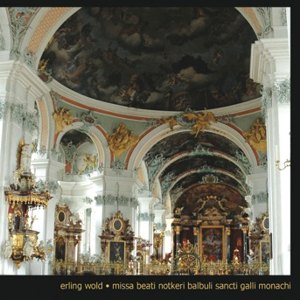
The San Francisco Composers Chamber Orchestra played the Mordake Suite #1 on Saturday. After a bit of studio magic I have a pretty good recording of it here. I was originally supposed to be in Europe for the premiere of the Notker Balbulus Mass on Saturday, but sadly it was delayed until next year, the cruelest month of next year that is. Fortunately my friend Robert Wechsler had the foresight to call the Kappelmeister before heading on the train to St Gallen. And, in related news, several key collaborations for the San Francisco Arts Festival next year have been announced and note my name in print. Smallish print maybe but ah, for this we live.

Labels: , , , , ,

Sunday, September 9, 2007

Fashion Victim

We have a personal seamstress we keep chained in the basement, our own Irish indentured servant, whom we picked up in Montserrat from a white slave trader in 1655, our dear friend Kathleen Crowley, who just blogged about one of your humble narrator's many items of clothing which she has produced for him, fingers bleeding, legs cramping up from the cold and damp. She had recently escaped from a hareem where she learned the tribal ways. I highly recommend having your own, especially if you are into local and sustainable and handmade fashion. My ex-wife used to call me a clothes horse which I always took as a compliment but I just looked it up to find the following definition: informal often derogatory a determinedly fashionable person. Yes, that's me, determined and resolute in my achievement of slavish fashionhood.

Labels: , , ,

Saturday, July 21, 2007

Prettification

To Melpomene, as the muse of the tragic descent and the nightmare of addiction, I now give dominion over the adornment and engineering of drug paraphernalia; the detailing of the LSD blotter; the spidery small microcosmic worlds of the speed freak, lathering up a fever at four in the morning at All Star donuts, unable to eat but unable to move, pens laid out in neat rectangles; the shiny polished chrome of the espresso machine; the long lathed ivory cigarette holder and its companion death's head Zippo lighter; the carved meerschaum pipe direct from Turkey with resin screen but (if sold in California) please only for tobacco. But I reserve for the one of many hymns, the muse of the sacred song, the beautification of musical instruments, a sacred musical task if there ever were, sweet lovely but most serious Polyhymnia, a finger held to her mouth to keep us quiet as we look upon the adornment with awe.

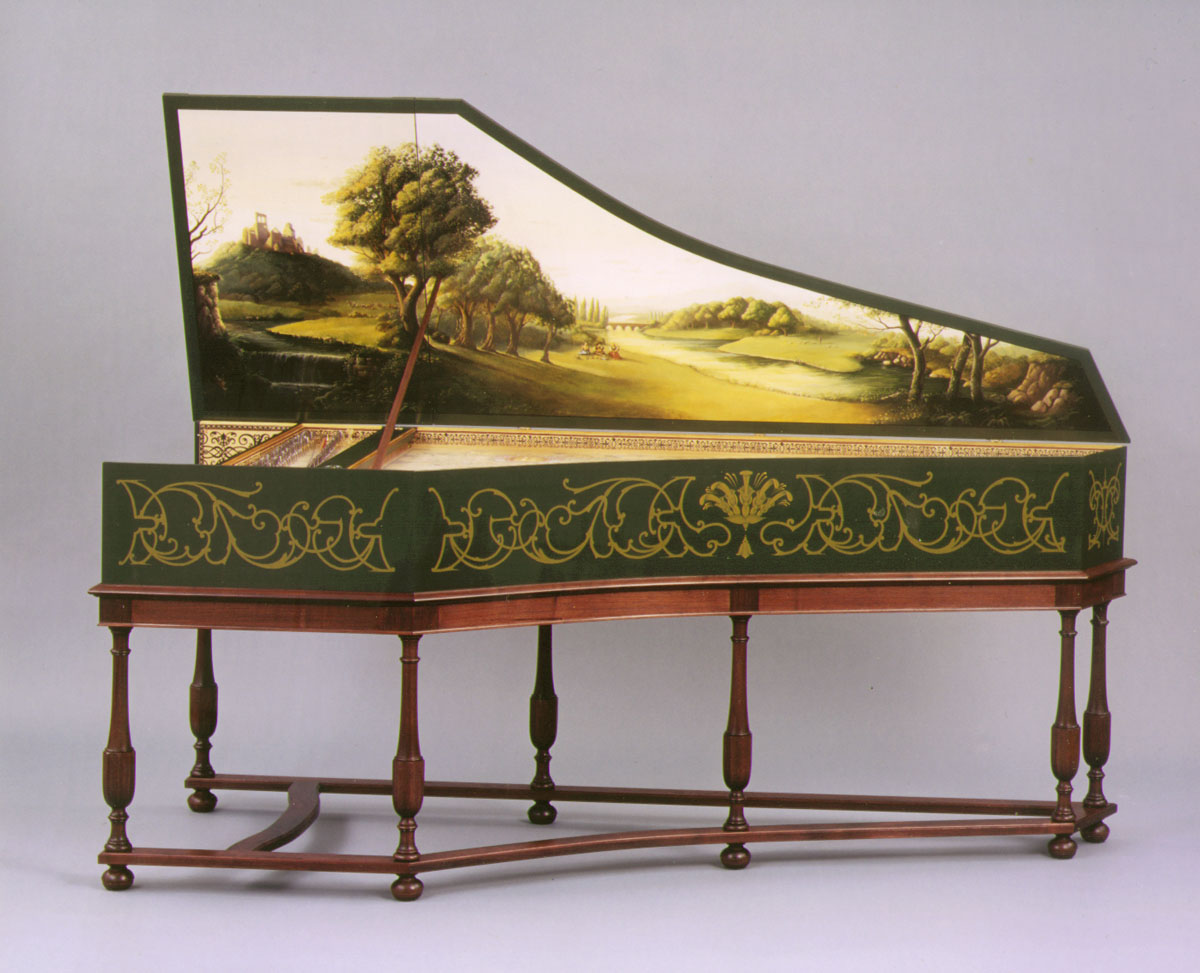
Oft-blogged Amy Crehore's very beautiful and hopefully first-in-a-series Tickler ukelele is above. Ooooh I want it. I just discovered that my son Duncan can play most all of the Hank Williams catalog and proved it to me at my mother's home using the same plastic-necked department store uke on which I first learned to play Little Brown Jug. And my favorite of Adrian Card's harpsichords is below. I want that too. I can't play the harpsichord so well and they are surprisingly quiet for those of us raised on 'lectric guitars and synthesizers but lovely as a dream when played well.

Labels: , , ,

Thursday, July 12, 2007

Friedrich der Große

My old friend Frieder Weiss tootled over the cold Arctic wastelands on a barbarously early flight out of Nürnberg to come to the barren industrial wastelands of West Oakland to work on the Mordake opera. Or whatever we are calling it. There doesn't seem to be a good equivalent to the German word for musiktheater in English. It's either Opera, with all its connotational baggage of heavy breasted women caterwauling dying words of lament, lungs ravaged by tubercles, or it's the milksop of Musical Theater, prancing and skipping its way in to the listener's heartstrings by any means necessary.

Mordake
threatens to be a radical departure for me in a number of ways, a primarily electronic piece with actual improvisational development, prying just the smallest iota of control from my cold dead fingers both socially and electronically. Plans call for visual and aural interactivity abounding throughout, controlled through John's movement and vocal pitch and spectrum and who knows what else. I'm feeling to be in my element this next week, parading with a cavalcade of the best and brightest, fingers on the keyboards, constructing something from nothing by the force of our will.

Labels: , , , ,

Monday, July 9, 2007

It is with such baubles that men are led

The powers that be, in their capricious omniscience, have bestowed an honor on my dear love Lynne Rutter, who has now joined the decorative painting ionosphere. Unfortunately it comes with no estate nor servant, but 'tis a joy nonetheless.

Labels: ,

Friday, June 15, 2007

Just fucking figure it out already

In the olden days, artists had the ability to actually do something, to complete something, to present a work complete, like Athena born whole from the head of Zeus. This is no longer a possibility. Now it seems that artists must only explore, consider, collaborate, engage in dialog, but please to never actually conclude, to state, to stand firm. I, for one, have little interest in seeing an artist's process, or knowing from whencesoever they came. Rather, I would prefer for them to go away, to leave me alone while they scrive their small efforts, staving off that time of the reaping of their souls, and then, when they have finished exploring and considering and collaborating, to share their destination with me, Lake Victoria in all its glory, and to skip the slide show, the home movies of their long and difficult trip up the Nile.

But, before I go, let me share just a few examples of what is raising my pique. OK? Yes. Here we go:

... will explore the ambiguous and changing nature of our relationship to living in a post-private society, where personal electronic information ...

The play will explore the rise in America of new white male empowerment in relation to a diversifying American culture.

The overall intention of the work is to explore the nature of communion with the infinite, and the opening of--the soaring of--the human heart. ...

The work will explore architecture as a fundamental, subliminal force intervening in the human narrative, braiding artistic exigencies, topical dramas and ...

...will explore the historical origins and the complex identity issues faced by conversos while speaking to the larger question of ...

In our sex comedy, we have outlined the following scene:

Arts Commision: banker, bishop, duc and judge, done as a scene from 120 days of Sodom. Old whore reads from the proposals typing notes on a laptop while the work samples are played and the four discuss. The four on the jury take off on tangents about fucking boys in chambers, shitting on the host, stuffing cash up the cunt of a prostitute. The old whore tells a story inspired by at least one of these. My work sample could be a setting of jet of blood. Jim’s lyric poem on the first 15 seconds after a consecrated host (at what point does it transubstantiate?) enters a whore’s vagina (pushed in by the black priest’s cock (editor's note: black as in black mass, not black as in African American)). The latter is what triggers the cash in cunt of prostitute story. They don’t like our proposal. It is clear they do not understand it. The second proposal The SHEro of the Warsaw Ghetto is an uplifting story about the Jewish uprising told entirely by shadow puppets viz the Platonic shadows on the cave wall, stolen by Plato from an older matriarchal tale. Use the following words: depucelate, cuntishly, sapphotizings, friggeresses.

Labels: , , , , , , , ,

Sunday, June 10, 2007

Amy Crehore

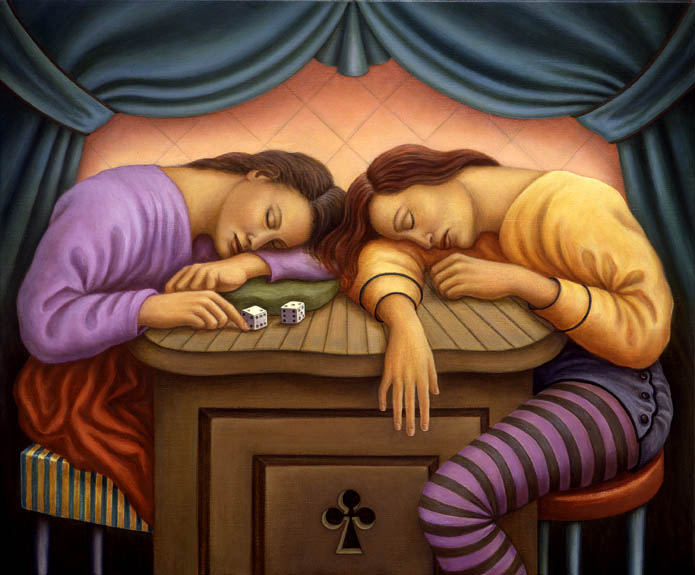
Let's take a moment to consider one of my favorite paintings. In the collection of the artist. I have a few of Amy's prints above my piano just below Vera where I meditate on them while I work. In a quid pro quo, she at times listens to The Bed You Sleep In in between the blues and the hokum when she is working. It makes me happy to think that, possibly, I've left a small impression. Maybe a brush stroke that took a small turn to reflect a particularly lovely note on the viola, maybe a color that ended up a slightly darker hue as a static sad sawmill loop sounded.

Labels: , , ,