Indulgence
posted by Erling Wold at
1:34 AM
0 Comments
Links to this post


Labels: composition, mass, music, religion
posted by Erling Wold at
4:34 PM
3 Comments
Links to this post
 A great number of demons in the Vatican, some quite voluptuous, some rakish, some horrific, but all kinda appealing. While we all hope for an eternity spent in quiet contemplation of the Celestial Visage, the fires of Hell and the activities of its residents make a far more winsome subject for the visual arts.
posted by Erling Wold at
11:00 AM
1 Comments
Links to this post
A favorite moment from The Bed You Sleep In, where Thomas Morris as the oracle has just hinted at Ray's impending doom. He recites a bit of Revelation 14 and we head off on one of Jon's landscape love-ins. Jon told me that the location of a story was as important to him as plot or character and deserved equal time. The music that starts about one minute into the clip is almost entirely derived from field recordings that Josh Rosen and I made of the local sawmill in Toledo, Oregon, now closed down because, as they discuss in the movie, you can't get any of the big trees anymore. (And why not, you ask? Because they really did clearcut the whole state and ship the uncut trees off to Japan.) But the sawmill was a beautiful aural environment. Walking through it was like listening to a futurist symphony and the raw recordings were beautiful, but of course I felt like I had to prettify it all a bit, and I think I was successful in that. I've bumped up the volume of the music in the clip so that it is a bit more intense, but you can hear the original music here or on the full soundtrack recording here.
Labels: collaboration, composition, film, jon jost, music, religion
posted by Erling Wold at
7:51 PM
0 Comments
Links to this post
 Since Jesus was assumed bodily into heaven, there aren't many bits of him available to venerate, but a lovely umbilical cord reliquary is just a block up from our Paris Apartment at the Cluny (see to the right: De Umbilico Domini Jesu Christi) and of course there are the many pretenders to the præputium scattered about Europe.
Labels: art, beauty, interior design, opera, religion, sexuality
posted by Erling Wold at
5:37 AM
0 Comments
Links to this post
 In Saint-Sulpice, where my dear friend and mentor Donatien Alphonse-François de Sade Marquis was christened on a balmy summer day early in the month of June (Prairial for my Republican readers) 1740 and where Marcel Dupré was the organist for many years. The Paris Meridian runs through the church and also through the gaggle of Dan Brown fans tapping the floor to find the secrets to the Sanct Grael hidden below. Went to ISMIR in Vienna last week. A lot of people using MFCCs for similarity just like the old Muscle Fish patent. Had dinner with my good friend Mariko Wakita who played the Marceline-Marie rôle in die Nacht wird kommen... in Klagenfurt and Brühl and the singing Jenny in Blinde Liebe. Richard Friedman is going to play the Mordake Suite #1 on Music from Other Minds on the weekend. Talked to Mrs. Childs about how "Freddy" Hundertwasser used to hang around her dining room window to see if they were eating so he could seem to be serendipitously stopping by and, oh, are you eating, why yes, I'll just have some bread with butter. Has anyone else noticed how most artists are poor during their life and are capitalized on after their death? Yes, of course, we all know.
posted by Erling Wold at
7:37 AM
0 Comments
Links to this post
 Faithful readers know that my Mass is premiering this fall in St Gallen, Switzerland. But they may not know that to the south of the city is the canton of Appenzell, represented by the flag above. In heraldry-speak: Argent, a bear rampant sable, armed langued and priapic in his virility gules. Translated: on a silvery white field, a bear is represented standing on one hind foot with its forefeet in the air, in profile, facing the dexter side, with right hind foot raised, in black, with red claws and erect penis of red tincture.

Labels: composition, mass, religion
posted by Erling Wold at
11:39 PM
3 Comments
Links to this post
 My Missa Beati Notkeri Balbuli Sancti Galli Monachi will be performed at the beautiful Abbey of St Gall in Switzerland on the Day of Repentance and Prayer (15 September). The Abbey was the commissioner of the piece, and it is thus named after one of their most famous, the musician and poet Notker Balbulus, aka Notker the Stammerer (840-912, beatified 1512). He is known as the first ethnically German composer of music and for publishing the first collection of Sequences, mnemonic poems for remembering the series of pitches sung during a melisma in plainchant, many composed by him. The stammering little monk "was so much loved by the monks of his abbey that for a long time after his death, they could not speak of him without shedding tears."
Labels: composition, mass, religion
posted by Erling Wold at
8:59 AM
0 Comments
Links to this post
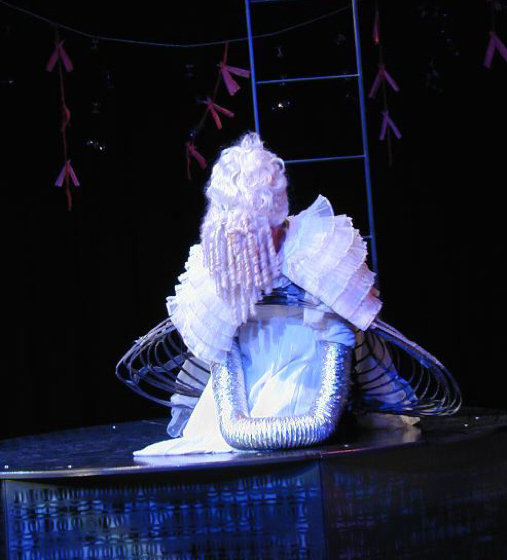 I was raised in a religious family and the iconography, the ritual, the warm embrace of Christianity are all felt strongly in me, but at a young age I was seduced by art, literature, even by seduction itself; in my dreams, the symbols of one and the other, its shadow, were mixed and confused, synthesizing a new self, more base, less seraphic, a fallen angel who shall never enter into paradise but, like Moses, will die while gazing upon the promised land, the celestial city, a place of joy where honey flows like water. The ecstasy of religion has been replaced by other ecstasies, those of the flesh, and those of the intellect, poor substitutes to be sure but, haven fallen so far and for so long, I have little else. The operas come from this place, mixing these worlds, the sounds formed by the slowly fading echoes of true religion, the cries of fleshly delight, the resonating in the hollowness of my soul.
posted by Erling Wold at
5:13 PM
Links to this post

Subscribe to
Posts [Atom]